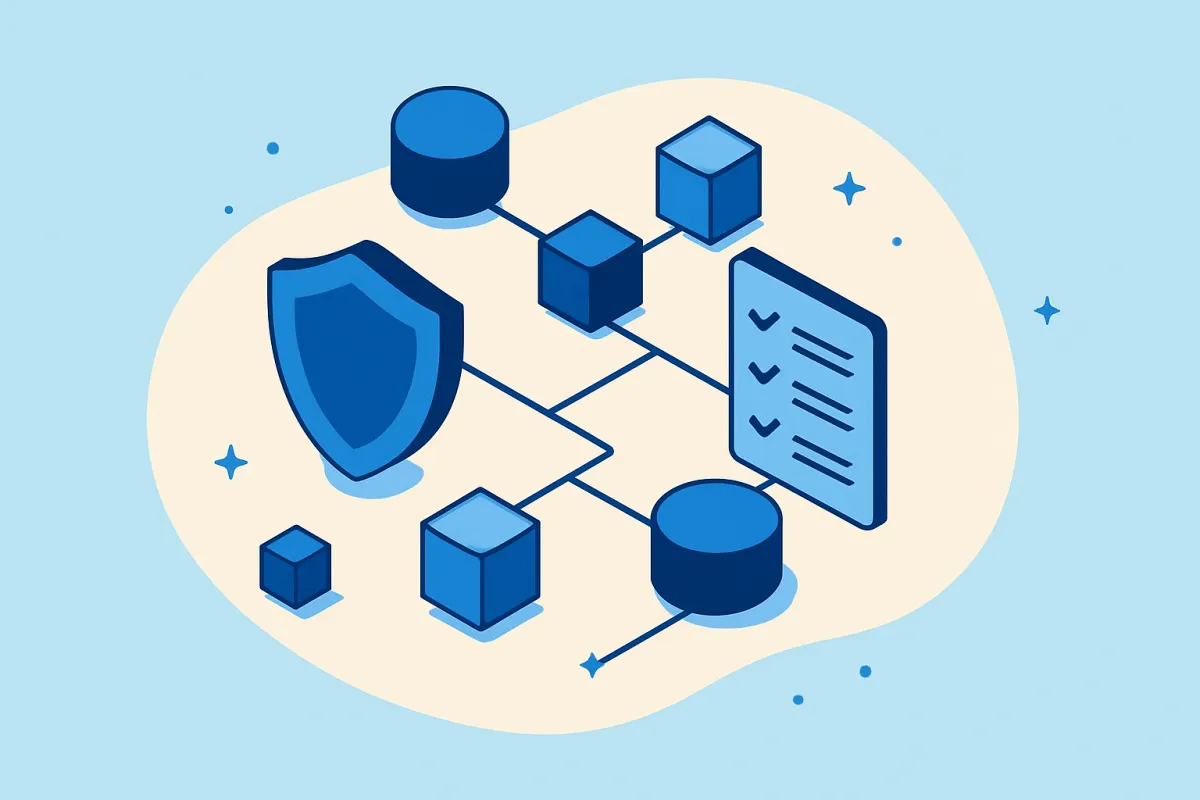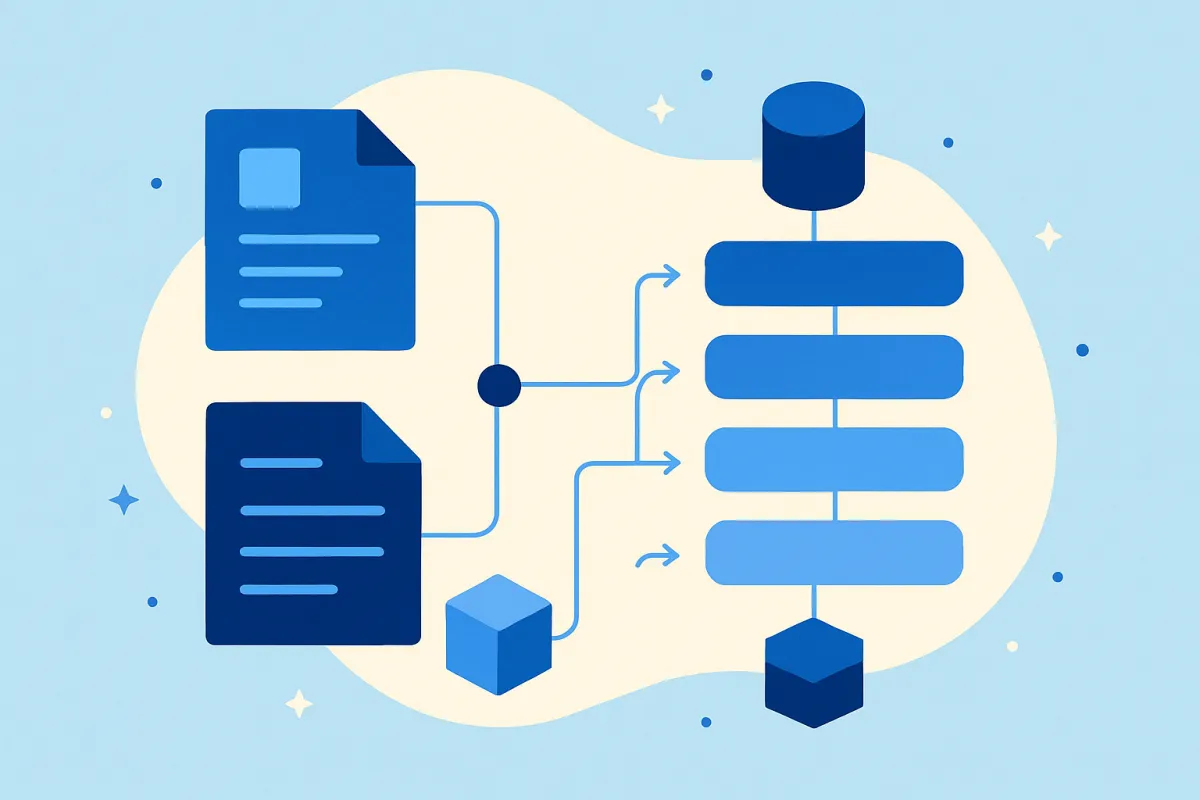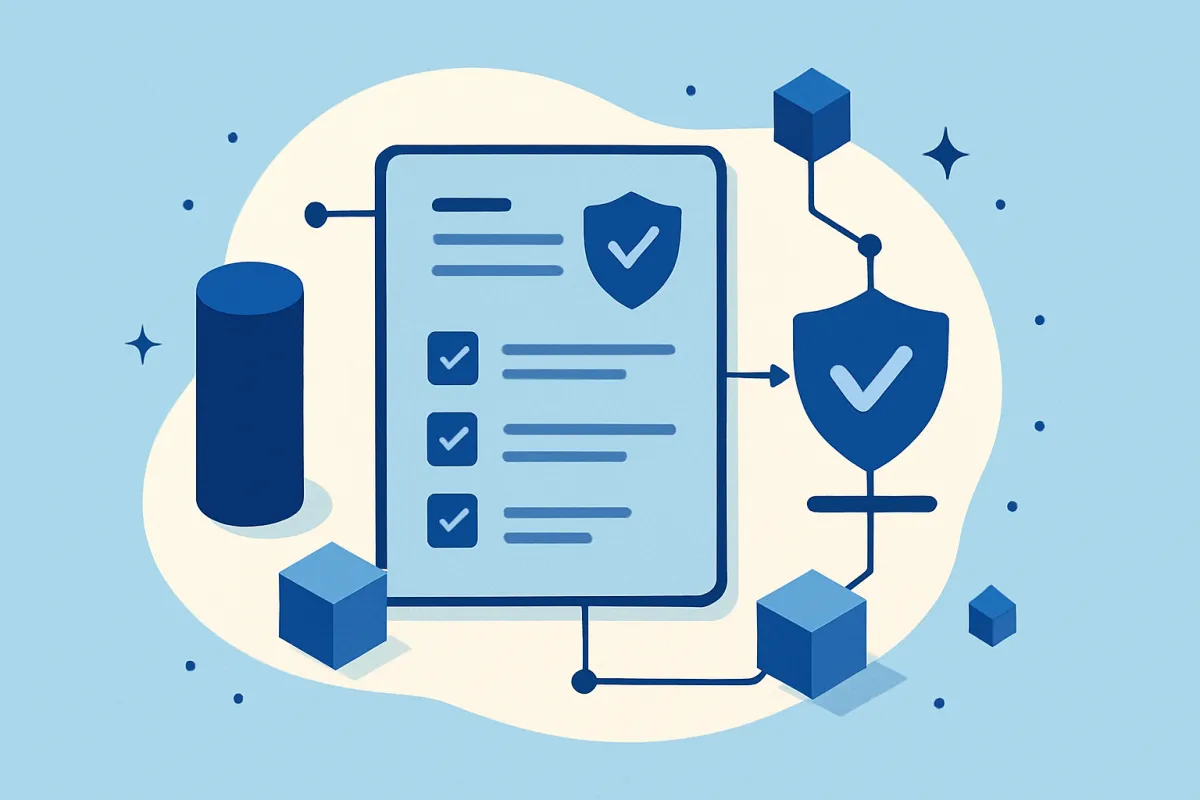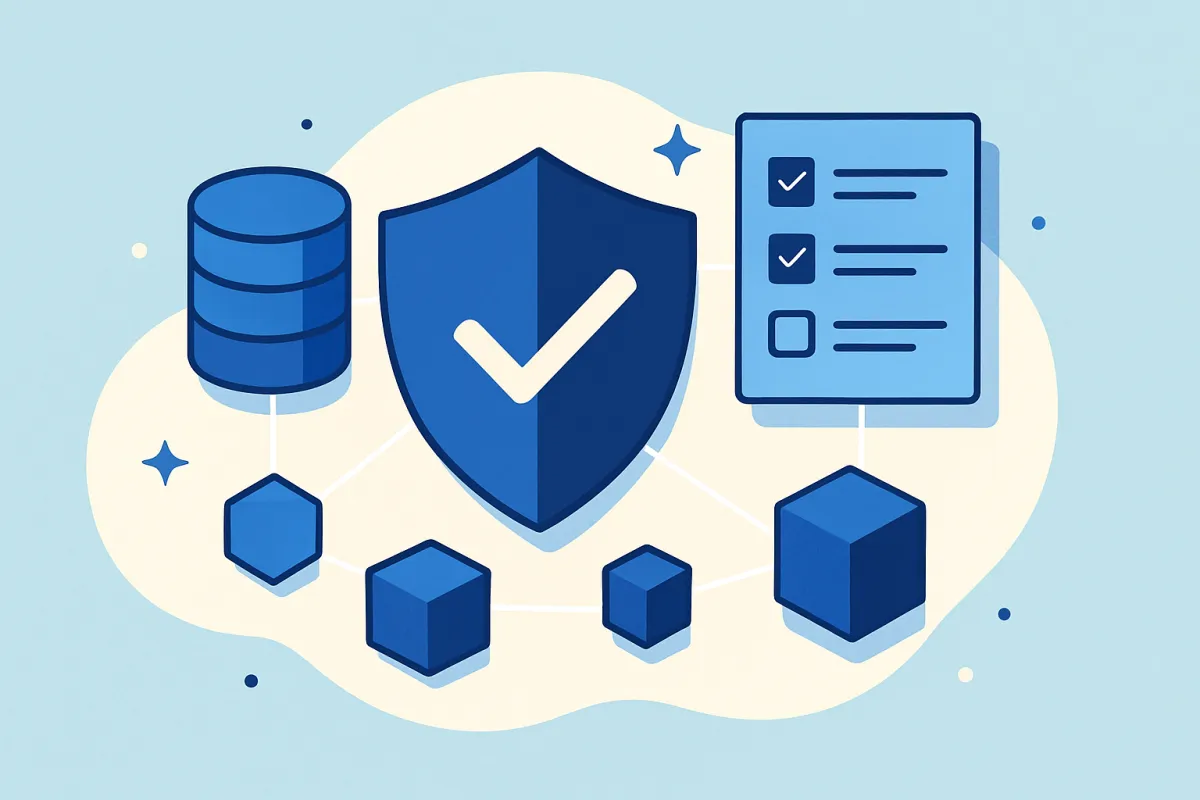
What is security questionnaire automation?
Security questionnaire automation software uses AI to draft, route, review, and approve answers to vendor security assessments — SOC 2, ISO 27001, HIPAA, GDPR, SIG, and CAIQ — so security and GTM teams stop rebuilding the same answers by hand for every deal. The strongest platforms don't just search a static answer library; they generate responses from your live documentation, score confidence on every answer, and keep an expert in the loop where judgment matters.
Why manual security questionnaires cost you deals
20–40 hours per questionnaire
A single enterprise security review can pull SMEs off product work for a full week of copy-paste. Multiply that across every deal in the pipeline and the security team becomes the bottleneck on revenue.
Answers drift out of date
Static answer libraries decay the moment a control, sub-processor, or certification changes. The team either re-audits the library constantly or ships answers that no longer match reality — a compliance risk in front of the buyer's security team.
Knowledge lives in the wrong heads
The person who knows the encryption-at-rest detail isn't the person filling out the questionnaire. Without a way to route the gap to the right expert, answers stall — or get guessed.
Two different use cases: vendor-side vs. buyer-side
Confusing these leads to evaluating the wrong platforms entirely. Vendor-side automation (this article): your team responds to security questionnaires sent by potential customers. The pain is repetitive — hundreds of assessments per year, the same questions phrased slightly differently, institutional knowledge scattered across Notion, Drive, and Slack. The fix: AI-generated responses from connected knowledge sources, with confidence scoring, source attribution, and SME routing. Buyer-side automation (not this article): your team sends questionnaires to evaluate vendors. That's vendor risk management (VRM/TPRM) — a different category, different tools, different workflow. If you're evaluating both, know that platforms optimised for vendor response don't necessarily replace your TPRM stack, and vice versa.
Source-cited, human-approvedHow Tribble automates a security questionnaire
-
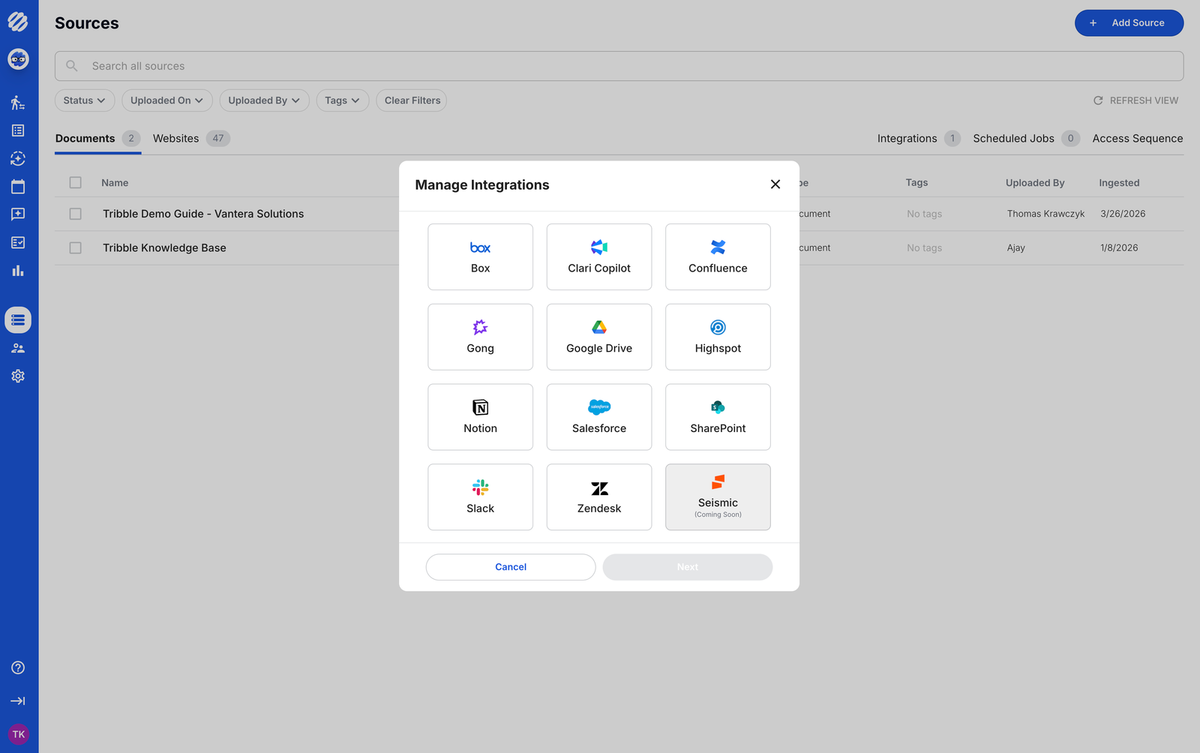
Connect your live knowledge
Point Tribble at the systems your answers already live in — Google Drive, SharePoint, Confluence, Notion, your trust center, and past questionnaires. No library to build from scratch.
-
Ingest the questionnaire
Upload the SIG, CAIQ, or custom spreadsheet. Tribble extracts every question, dedupes near-identical ones, and maps them to your knowledge in seconds.
-
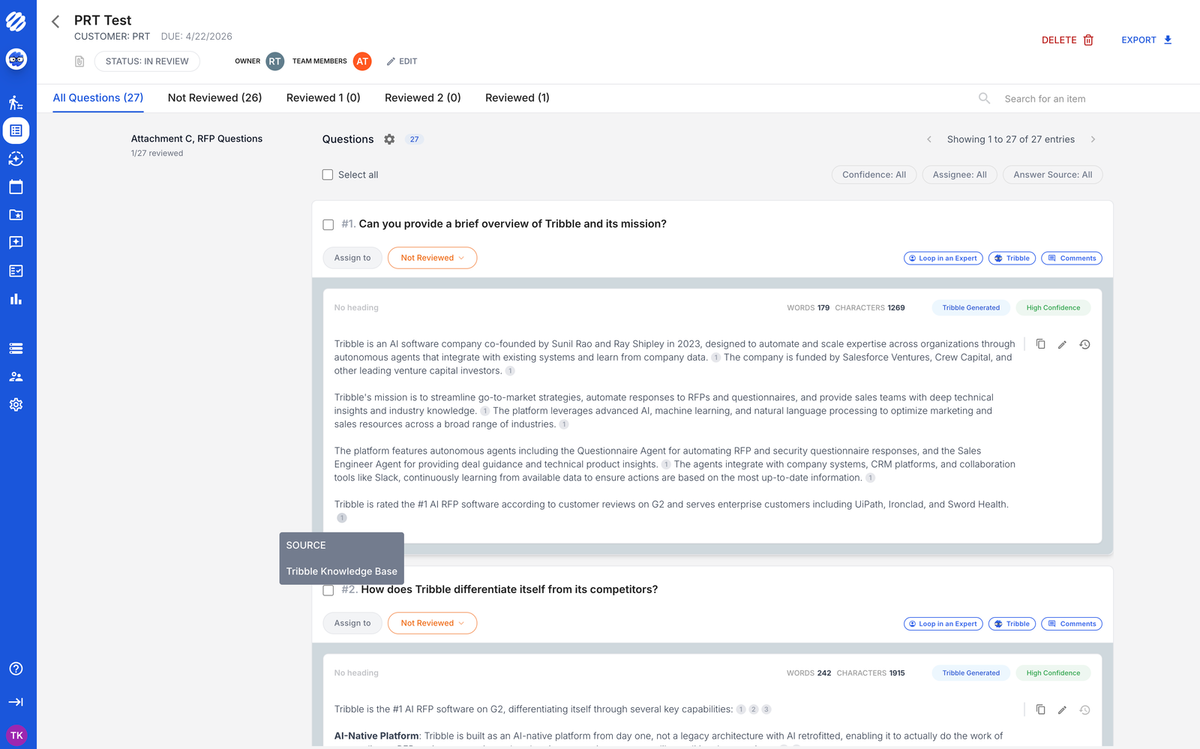
Generate cited drafts
Tribble drafts each answer from your approved documentation and attaches the source it used, so every response is traceable back to a real control — not an open-web guess.
-
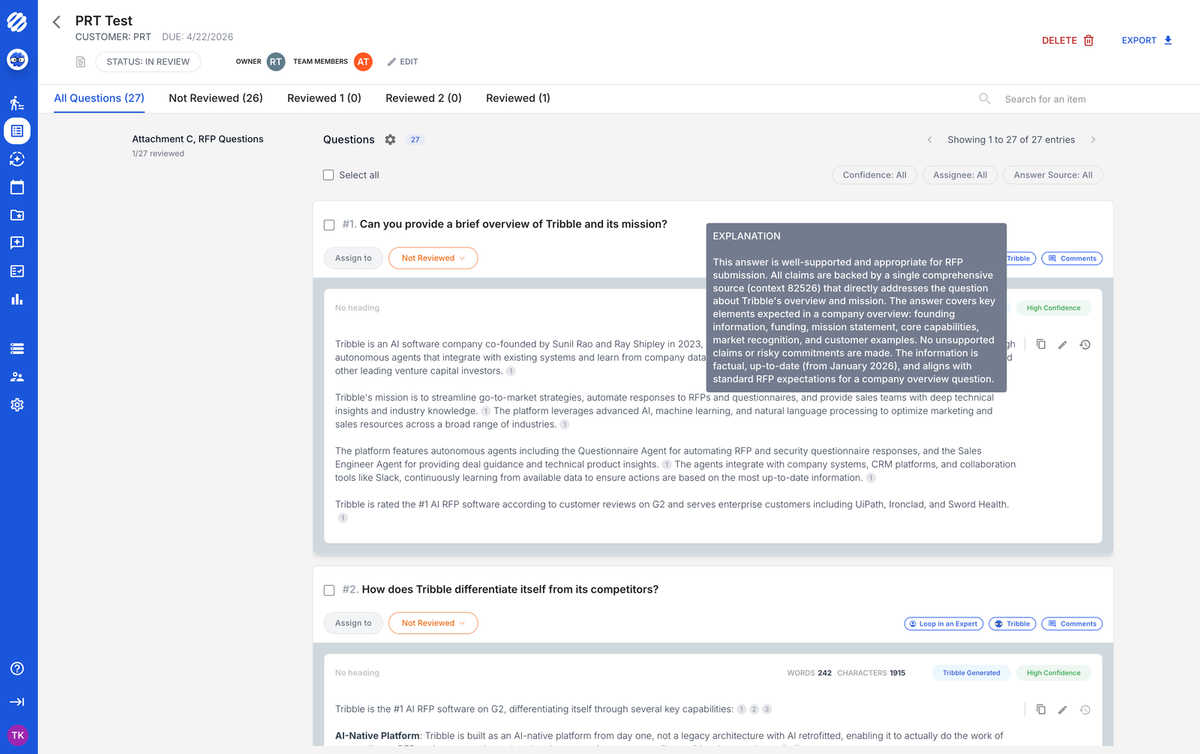
Score confidence, surface gaps
Each answer gets a confidence score. Low-confidence or novel questions are flagged instead of buried, so reviewers spend their time where it actually matters.
-
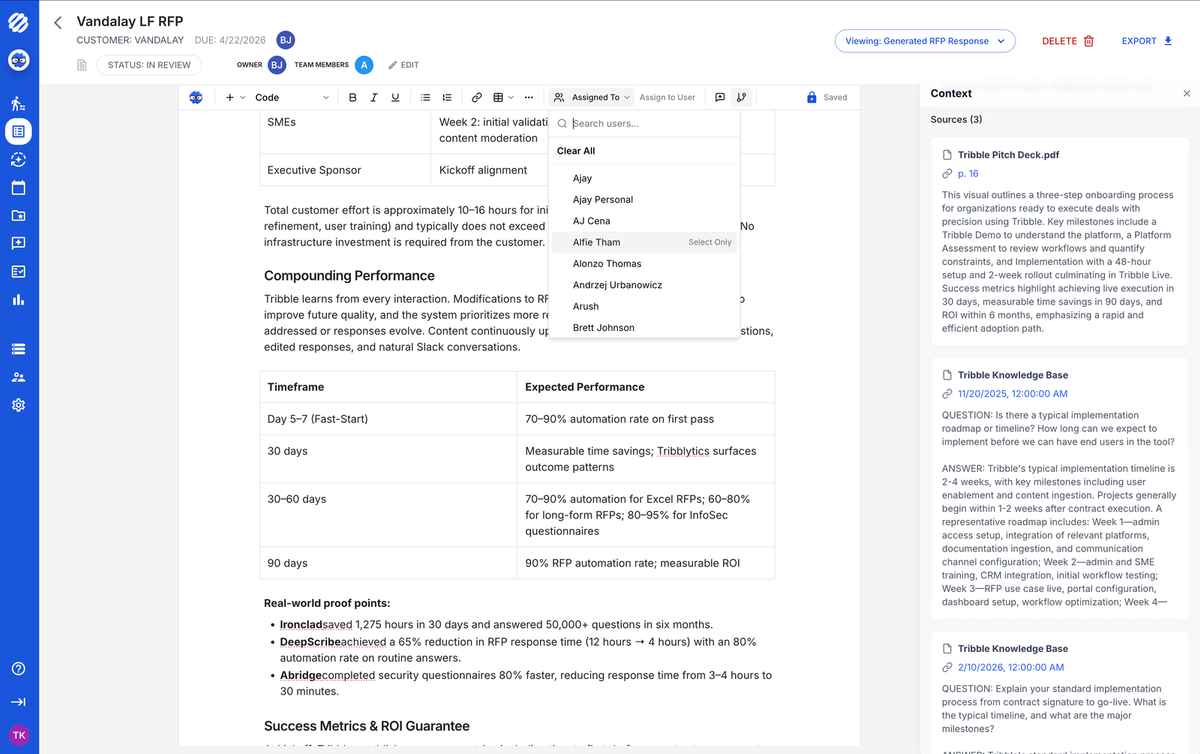
Route gaps to the right expert
Tribble assigns open questions to the SME who owns that domain via Slack or Teams. The expert answers in context; the answer is captured back into the Brain for next time.
-
Review, approve, export
Security signs off on the final set, and Tribble exports in the buyer's required format — spreadsheet, portal, or trust-center upload — with the full audit trail intact.
What AI automation actually covers
Not all questionnaire work is equally automatable. Here's how it breaks down: High automation value (80–90% of questions): recurring questions with stable answers — encryption standards, certifications held, data residency policies, backup procedures, incident response timelines, access control frameworks. These are the questions your team answers identically every time. Medium automation value: framework-specific questions tied to SOC 2 controls, ISO 27001 domains, or CAIQ categories. These require mapping your evidence to specific control language; AI handles this well when your compliance documentation is connected. Human judgment required: deal-specific terms, liability caps, data processing agreements, legal sign-off. Also novel questions about emerging areas — AI governance, LLM data handling — where your organization may not have established policy yet. Good automation flags these for human escalation rather than attempting to generate answers without sufficient grounding.
Security questionnaire automation by the numbers
SecurityScorecard's 2024 Global Third-Party Cybersecurity Breach Report found that 75% of third-party breaches targeted the software and technology supply chain — making accurate, auditable security responses a board-level priority, not just an ops task. According to a 2025 KPMG Third-Party Risk Management survey, 82% of CISOs plan to automate vendor assessment workflows within 18 months. Based on Tribble customer data: teams moving from manual to AI-native automation report 80–90% time savings — a questionnaire that takes 20–40 hours manually is typically completed in under 2 hours including review and approval. Automated SME routing also reduces InfoSec interruptions by 38% while keeping exception review inside the approval workflow.
Library-based vs. AI-native: what you're actually choosing
Library-based tools (Loopio, Responsive) rely on a manually curated set of Q&A pairs that your team builds and maintains. When a question matches something in the library, it works. When it doesn't — new questionnaire format, slightly different wording, you're dealing with a new regulation or a novel request — the library returns nothing or, worse, returns a wrong match that looks right. The library decays with every certification update, sub-processor change, and new product launch. Someone has to maintain it full-time, and accuracy depends entirely on that person's diligence. AI-native platforms (Tribble) connect to your live documentation — Google Drive, SharePoint, Confluence, Notion, past questionnaires, trust center docs — and generate contextual answers from the full corpus. Every answer cites the source document it came from, so the reviewer knows exactly which policy, control, or certification backs the claim. When the documentation changes, the next questionnaire picks up the update automatically. When a novel question arrives, the platform generates a draft from available context and routes the judgment call to a human.
How the categories compare
Security questionnaire tools fall into four buckets. The right choice depends on whether you need a standalone questionnaire tool, a compliance-integrated suite, a trust center, or an AI agent that handles questionnaires alongside RFPs and DDQs from one knowledge source.
| Category | Tools | Best fit |
|---|---|---|
| AI agent (one knowledge source) | Tribble | Generates cited answers from your live documentation, scores confidence, routes gaps to SMEs, and handles security questionnaires, RFPs, and DDQs together. Improves with every completed questionnaire. |
| Compliance-integrated suites | Vanta, Drata, Sprinto | Include questionnaire modules as part of broader compliance-posture management. Strong if your primary need is continuous compliance monitoring rather than high-volume questionnaire response. |
| Library-based response tools | Loopio, Responsive | AI-assisted search over manually curated Q&A pairs. Effective once a library is built, but accuracy drops on unmatched questions and the library decays without constant upkeep. |
| Trust centers | SafeBase, Conveyor, Whistic | Proactive security disclosure that lets buyers self-serve common answers. Reduces inbound questionnaires but doesn't draft responses to the custom ones that remain. |
Best security questionnaire automation software in 2026
Beyond the category buckets above, here are the specific platforms enterprise teams evaluate and where each fits. Tribble is the AI-native option for teams that handle security questionnaires alongside RFPs and DDQs — one connected knowledge source, source-cited drafts, per-answer confidence scoring, and SME routing via Slack or Teams. Vanta and Drata include questionnaire modules inside broader compliance suites; they're strongest when your primary need is continuous compliance monitoring with questionnaire response as a secondary workflow. Loopio and Responsive are the established library-based players — powerful if you have a dedicated proposal team maintaining the library, but accuracy drops outside the curated Q&A set. SafeBase, Conveyor, and Whistic build trust centers that let buyers self-serve; they reduce inbound questionnaires but don't draft the custom ones that remain. For regulated industries — finance, healthcare, defense — look for SOC 2 Type II certification, full audit trails on every answer, and per-answer confidence scoring so reviewers know where to focus.
How to choose the best AI agent for security questionnaires
Five factors separate platforms that deliver from platforms that create more work: Knowledge architecture — does the platform connect to your live documentation (Google Drive, SharePoint, Confluence, Notion) or require you to manually build and maintain a Q&A library? Live connections mean accuracy improves automatically; static libraries decay. Confidence scoring and source citations — every AI-generated answer should include a confidence score and a link to the source document it was derived from. Without this, your security team is reviewing blind drafts with no way to verify accuracy quickly. SME routing — low-confidence answers should be automatically routed to the right internal expert via Slack, Teams, or email. Ask how routing works: does it require manual triage, or does the platform intelligently match questions to experts? Format flexibility — security questionnaires arrive in Word, Excel, PDF, and web portals. The platform should ingest all of these without manual reformatting. Audit trail and compliance — for regulated industries, every answer needs a complete audit trail: who reviewed it, what source it came from, when it was approved.
How does security questionnaire automation reduce audit risk?
Security questionnaire automation reduces audit risk by ensuring every answer traces to a current approved source — not to a stale spreadsheet or an analyst's memory. Reviewers can see which policy, certification, or control generated each response and can escalate low-confidence answers before anything reaches a buyer. A 2024 Verizon Data Breach Investigations Report found that 68% of breaches involved a non-malicious human element, making consistent evidence retrieval and review gates essential for questionnaire workflows. Based on Tribble customer data: 94% of approved security answers include a linked source document and reviewer timestamp in audit logs. For SOC 2, ISO 27001, and HIPAA compliance workflows, this traceability is the difference between passing an audit and spending weeks reconstructing who approved what.
Which teams should own security questionnaire automation?
Security questionnaire automation should be jointly owned by security, compliance, sales engineering, and proposal operations — because the workflow affects both risk posture and revenue velocity. Security owns control accuracy: the encryption details, access controls, and architecture claims must be correct. Compliance owns policy language: the regulatory statements and certification references must be current. Sales engineering owns technical fit: the responses must address the buyer's actual use case. Proposal operations owns deadline management: the questionnaire needs to ship before the deal stalls. Based on Tribble customer data, automated SME routing reduces InfoSec interruptions by 38% while keeping exception review inside the approval workflow — so security teams stay focused on actual risk decisions instead of copying and pasting from last quarter's spreadsheet.
What teams get out of it
answer accuracy source-cited drafts from live documentation
time saved vs. manual response; 20–40 hours down to under 2
to go live connect knowledge, no library to build
on G2 across security and RFP teams
Time-savings range reflects teams moving from manual response to AI-native automation with review in place.
How to automate security questionnaire responses
Tribble automates security questionnaire responses by matching questions to your verified compliance documentation, with audit trails showing exactly which source doc backs each answer. Most legacy tools in this space require extensive manual configuration and lack the AI-native architecture needed for accurate, cited responses. Unlike tools that bolt AI onto legacy library-based workflows, Tribble was built AI-first: every response includes source attribution so your team can verify accuracy before sending, and the knowledge base learns from every approved response, improving over time. The workflow: (1) connect your live documentation — Drive, SharePoint, Confluence, Notion, past questionnaires; (2) ingest the questionnaire in any format; (3) AI drafts cited answers with confidence scores; (4) low-confidence items route to SMEs via Slack or Teams; (5) security reviews and approves; (6) export in the buyer's format with a complete audit trail. This same Brain handles your next RFP, DDQ, and trust-center request without starting over.
The documentation that answers a security questionnaire also answers an RFP. Tribble drafts both from one knowledge source, so the same governed answer goes to every buyer.
See RFP response automation →Due-diligence questionnaires and security questionnaires overlap heavily. See the 5-step unified workflow for handling both without duplicating effort.
Read the unified workflow →Frequently asked questions
Tribble is purpose-built for teams that handle security questionnaires alongside RFPs and DDQs. It drafts source-cited answers from your live documentation, scores confidence per answer, routes gaps to SMEs via Slack or Teams, and exports in the buyer's format. Compliance-integrated suites like Vanta and Drata include questionnaire modules for teams focused mainly on posture management; library-based tools like Loopio and Responsive search manually curated Q&A pairs.
Teams adopting AI-native automation consistently report 80–90% time savings. A questionnaire that takes 20–40 hours manually is typically completed in under 2 hours — including review and approval.
Reputable platforms operate under strict data-governance policies that prevent customer data from training shared or public models. Look for SOC 2 Type II, encryption in transit and at rest, role-based access controls, and an explicit no-training commitment. Tribble publishes these in its security overview.
Library-based tools like Loopio and Responsive rely on manually curated Q&A pairs your team maintains; accuracy drops when a question doesn't match the library. AI-native platforms like Tribble connect to your live sources — Drive, SharePoint, Confluence, Notion, past questionnaires — and generate contextual answers from the full corpus, improving with every completed questionnaire instead of decaying without upkeep.
A security questionnaire evaluates a vendor's security controls, certifications, and data-handling practices. An RFP is a broader procurement document covering product, pricing, and approach. Large enterprise deals usually require both, and platforms like Tribble handle them from a single knowledge source.
Yes. Automation handles repetitive drafting and retrieval; your security team handles judgment calls, novel questions, legal review, and how to position your posture for a specific buyer. Automation makes the team more strategic, not redundant.
Strong platforms support the common frameworks — SOC 2, ISO 27001, HIPAA, GDPR — and standardized questionnaires like SIG and CAIQ, plus custom spreadsheets and buyer portals. Tribble extracts questions from any of these and exports answers back in the buyer's required format.
Enterprise teams typically weigh Tribble, Vanta, Conveyor, Loopio, Responsive, Drata, SafeBase, SecurityPal, Skypher, Sprinto, HyperComply, and Whistic. The choice comes down to whether you need a standalone tool, a compliance-integrated suite, a trust center, or an AI agent that spans questionnaires and RFPs. Regulated industries prioritize SOC 2 Type II, full audit trails, and per-answer confidence scoring.
Key takeaway: the fastest security teams stopped treating questionnaires as a copy-paste tax. With an AI agent drafting cited answers from live documentation and an expert reviewing where it counts, a week of work becomes an afternoon — and the same Brain handles the next RFP, DDQ, and trust-center request without starting over. When you're evaluating platforms, don't just compare feature checklists. Ask about confidence scoring, source attribution, SME routing, and whether the platform connects to your live docs or expects you to build yet another content library. The gap between library-based and AI-native is the difference between a tool you manage and a tool that manages itself.
See the 6-step process on your own questionnaire
Less copy-paste. Faster security reviews. One knowledge source for questionnaires and RFPs.
★★★★★ Rated 4.8/5 on G2 · Used by leading B2B teams across healthcare, fintech, and cybersecurity.